
A multidimensional framework for assessing the financial strength, institutional quality, client protection and external risks of microfinance institutions across emerging and frontier markets.
Looking beyond the balance sheet

Investing in inclusive finance requires looking beyond financial performance alone. The long-term resilience of a microfinance institution (MFI) also depends on the quality of its governance, risk management, business model, client protection practices and ability to operate responsibly in changing markets.
This is particularly important in emerging and frontier markets, where regulatory, macroeconomic and social conditions can evolve rapidly.
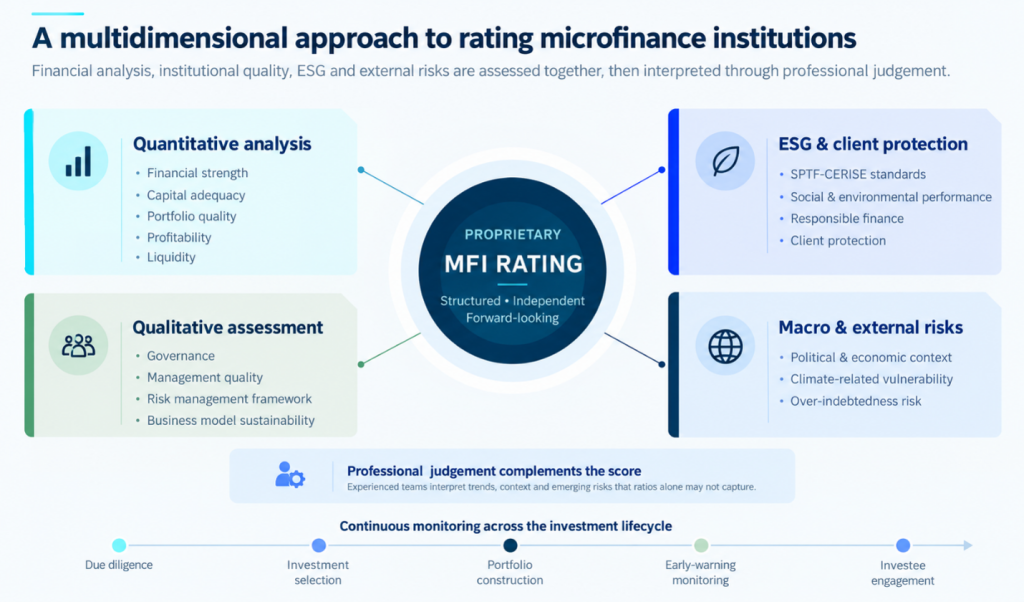
To assess these dimensions coherently, FS Impact Finance has developed a proprietary MFI rating methodology. It combines financial analysis with institutional quality, ESG and client protection considerations, and external risk factors. The rating supports the investment process from initial due diligence and investment selection through portfolio construction, monitoring and investee engagement.
The objective is not simply to produce a score. It is to develop a structured, independent and forward-looking view of each institution's strengths, vulnerabilities and long-term resilience.
Why a broader assessment matters
Traditional credit analysis remains fundamental. Capital adequacy, portfolio quality, profitability, liquidity and financial strength provide essential information about an institution’s ability to meet its obligations and withstand stress.
But financial ratios do not tell the full story. Governance, management quality, internal controls, responsible lending practices and risk culture can materially influence future performance. External developments – including political and regulatory change, inflation, climate-related risks or increasing borrower over-indebtedness – can also affect an institution before their impact becomes visible in its financial statements.
Our methodology therefore brings these different perspectives together.
A multidimensional rating framework
Quantitative analysis. To evaluate the financial strength of an MFI, we assess capital adequacy, portfolio quality, profitability and liquidity. Together, these indicators provide a view of balance-sheet resilience, operating performance and the institution’s capacity to absorb losses and sustain future growth.
Qualitative assessment. For the assessment of the MFIs governance framework, we examine management quality, strategic decision-making, internal controls, risk management and the sustainability of the institution’s business model. These factors help us understand how effectively an MFI is positioned to respond when market conditions change.
ESG and client protection. Our assessment builds on internationally recognised Cerise+SPTF social & environmental performance management standards and established client protection tools. We consider responsible finance practices, treatment of clients, environmental and social performance, and the extent to which these principles are embedded in an institution’s governance and operations.
Macro and external risks. Country risk, political and economic conditions, climate-related vulnerabilities and country over-indebtedness form an integral part of the assessment. Combining institution-specific analysis with external factors and indicators like MIMOSA provides a more complete view of risk.
Professional judgement complements the score
A structured methodology is important, but investing is not a mechanical scoring exercise.
Two institutions can report similar financial ratios while having very different prospects. Differences in leadership, governance, underwriting discipline, competitive pressures or risk culture may not yet be reflected in headline financial indicators.
Our investment, risk and monitoring teams therefore complement the quantitative framework with professional judgement. Their role is to interpret trends, understand context and identify emerging risks that individual metrics may not capture.
This combination of structured analysis and experienced judgement helps make the rating both consistent and forward-looking.
Supporting decisions throughout the investment lifecycle

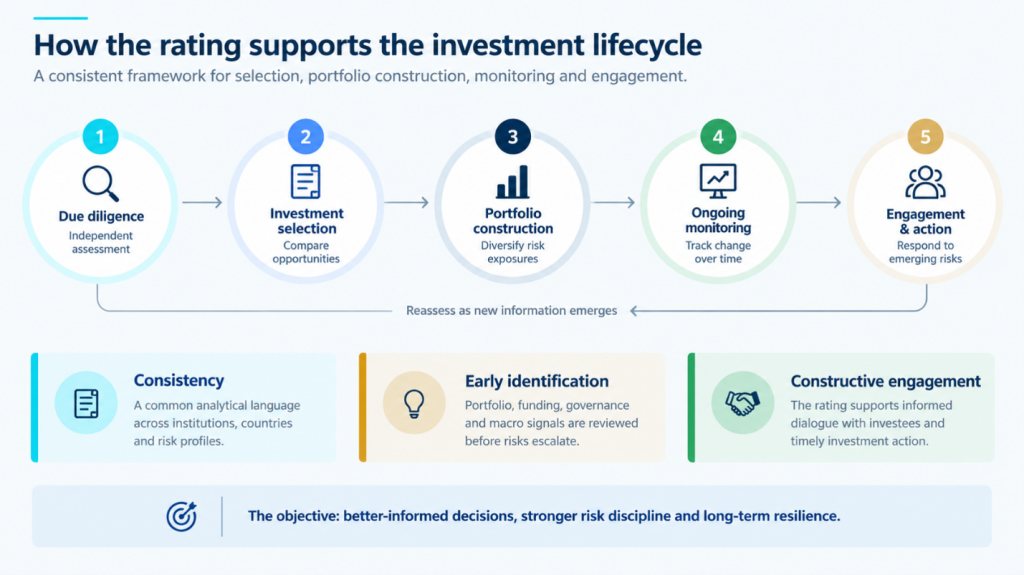
The rating is not limited to the initial investment decision. It provides a common analytical framework throughout the entire investment lifecycle.
Due diligence and investment selection. The rating supports an independent assessment of institutional quality and financial resilience and allows opportunities to be compared consistently across markets and business models.
Portfolio construction. Ratings help inform diversification across institutions, countries and risk profiles.
Ongoing monitoring and early risk identification. Ratings are continuously reassessed as new financial information becomes available and as qualitative or external conditions change.
Constructive engagement. The methodology helps identify areas where governance, risk management or operational practices can be strengthened, providing a basis for informed dialogue and timely action.
In this way, the rating creates a consistent analytical language across investment selection, portfolio management and investee engagement.
Responsible finance and financial resilience
Inclusive finance seeks to combine financial sustainability with meaningful social impact. We see these objectives as mutually reinforcing.
Institutions that lend responsibly, maintain strong governance and invest in effective risk management, are generally better equipped to navigate changing economic conditions. Financially resilient institutions, in turn, are better positioned to continue serving entrepreneurs, households and small businesses over the long term.
Our proprietary rating methodology reflects this connection. By bringing together financial analysis, institutional quality, ESG and client protection, external risks and professional judgement, it supports more informed investment decisions and disciplined portfolio management.
Ultimately, the objective is straightforward: to identify resilient financial institutions that combine financial strength with responsible lending practices and a lasting commitment to financial inclusion.
By applying a structured and independent methodology across the investment lifecycle, FS Impact Finance seeks to make better-informed investment decisions while supporting the continued development of responsible and inclusive financial institutions.