
The development finance paradox – and why someone still needs to take the risk
Development Finance Institutions (DFIs) and Multilateral Development Banks (MDBs) are frequently criticised for being too conservative. They are supposed to go where commercial capital will not, finance difficult markets, support innovative business models and help create investable opportunities where none existed before.
So why do they so often appear to arrive only once a company is established, a project largely de-risked and the difficult work has already been done?
AAA is a feature, not a bug
Let us start with something that is easily forgotten when discussing development additionality: there are very good reasons for MDBs to be financially conservative.
Their exceptional credit quality allows them to raise enormous amounts of money in international capital markets at very attractive rates. They can pass part of that funding advantage on to borrowers, provide long tenors that commercial lenders may not offer and, importantly, continue raising capital when financial markets become considerably less friendly.
That last point matters. When COVID-19 brought much of the global economy to a standstill, or when financial crises and external shocks suddenly make private capital scarce, the ability of a development bank to keep lending becomes particularly valuable. The G20 itself has emphasised the role of MDBs in providing development and countercyclical finance while preserving strong credit ratings.
In other words: asking an MDB to simply forget about its AAA rating and take considerably more risk would be missing the point. Financial strength is part of the development model.
But it has consequences.
Protecting the rating means protecting the balance sheet. Protecting the balance sheet means maintaining sufficient capital buffers, limiting concentrations and managing expected and unexpected losses. And that inevitably affects what an institution is comfortable financing.
Interestingly, the debate has moved beyond whether this happens. The 2022 G20 review of MDB capital adequacy frameworks asked whether the system had perhaps gone too far. OECD’s summary of that work notes that differing rating-agency methodologies can encourage MDBs to apply particularly conservative assumptions, build excessive buffers and ultimately operate at a risk appetite below what one might expect even for a AAA institution.[1]
So far, so reasonable. Until we look at the other side of the mandate.
Meanwhile, the job description keeps getting longer
Development institutions are no longer merely expected to finance infrastructure and economic development.
They are expected to address climate change. Operate in fragile and conflict-affected countries. Support small and medium-sized enterprises. Mobilise private institutional investors. Finance local businesses. Promote gender equality. Provide local-currency solutions. Support innovation and new technologies. Help countries mitigate climate change. Contribute to global public goods. Build markets rather than merely participate in them.
Ideally, all at once.
And while doing so, they are expected to remain financially sustainable, maintain very high credit ratings, preserve shareholder capital and keep non-performing assets under control.
Maybe the equation is slightly different: Perhaps MDBs/DFIs risk appetite has not fallen nearly as much as the riskiness of their mandate has increased.
The world is asking these institutions to go further into markets characterised by weaker institutions, greater political uncertainty, smaller companies, less developed capital markets and more volatile currencies – without fundamentally changing the financial architecture within which they operate.
That creates an inevitable tension.
What happens when the underwriting machine starts running?
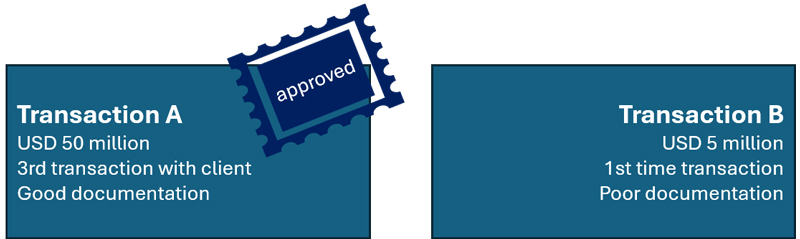
Now imagine an investment officer looking at two potential transactions.
Transaction A is a USD 50 million financing for an established company the institution has financed twice before. Management is known. Financial reporting is good. Environmental and social systems have already been reviewed. Documentation can build on previous transactions.
Transaction B is a USD 5 million investment in a younger company in a fragile country. The impact could be substantial. Commercial capital is scarce. Management looks capable but has never borrowed internationally. Financial information needs work. The transaction will require more due diligence, more monitoring and probably considerably more internal explanation.
Which transaction moves through the institution more easily?
No conspiracy needed: the institutional machinery naturally gravitates towards Transaction A.
An independent World Bank evaluation of IFC’s activities in fragile and conflict-affected situations illustrates precisely this problem. Transactions in these countries tend to be smaller, more uncertain, costlier to process and slower to close. Staff interviewed by the evaluators even raised concerns about the career implications of spending substantial time on difficult transactions that may ultimately never close.[2]
Repetition reinforces the effect.
The first transaction with a new counterparty can be painful. The second is easier. The third easier still. The institution already understands the management team, governance, business model and risk systems.
From the perspective of efficient capital deployment, that makes perfect sense.
From the perspective of market creation, however, it produces an uncomfortable result:
The institutions mandated to finance companies and markets that others do not know yet have a structural advantage when financing companies and markets they already know.
Proparco has made a similar point surprisingly openly. Looking specifically at fragile countries, it acknowledges that DFI resources and intervention requirements have historically diverted institutions away from smaller businesses, despite their importance to local economies, and argues that acceptable risk appetite and financing tools need to be adjusted.[3]
The additionality paradox
This leads to what might be called the additionality paradox.
At its simplest, the DFI proposition is:
We should finance something because commercial capital will not.
But the credit proposition remains:
We should finance something because we have reasonable confidence that we will get our money back.
Both principles are entirely sensible.
Combined, however, they create a fairly narrow corridor.
Move too far towards safety and the obvious question becomes why a development institution is needed at all. A highly profitable, well-capitalised company in a stable market with multiple commercial lenders knocking on its door may make an excellent investment, but its financial additionality is questionable.
Move too far in the opposite direction and a different problem appears. The young company with an unproven model, the first-time fund manager, the greenfield project several years away from revenues or the entrepreneur operating in a politically fragile market may demonstrate extraordinary additionality precisely because conventional finance is unavailable.
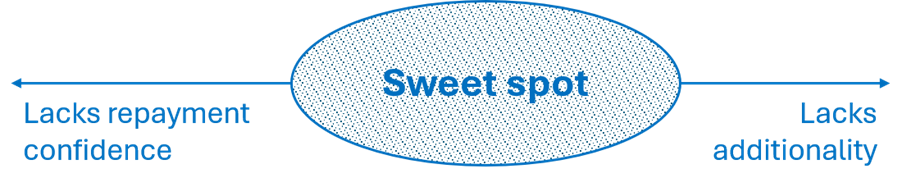
Unfortunately, the reasons commercial investors are staying away are often the same reasons a DFI credit committee gets nervous.
The “perfect” DFI investment must therefore be sufficiently difficult that commercial capital will not finance it – but sufficiently safe that the DFI still can.
There is nothing wrong with that in principle. The question is simply what happens to everything sitting just beyond that boundary.
Enter the development finance “bad bank”
The development finance system has actually developed a rather clever answer.
Separate the risk.
Not a “bad bank” in the traditional sense – nobody is dumping non-performing loans into a warehouse – but something conceptually similar: risks that do not comfortably fit the core balance sheet are placed into separate portfolios, windows or vehicles with different financial expectations.
British International Investment’s (BII’s) Catalyst Portfolio provides a particularly transparent example. Catalyst was created as a separate pool of capital to finance opportunities capable of producing greater development impact but carrying greater uncertainty than investments in BII’s conventional portfolio. It has an explicit 30% portfolio-level loss tolerance.
That number is fascinating.
Not because anyone intends to lose 30%. They do not. Individual investments are still expected to have a positive financial return.
What the loss tolerance does is something arguably more important: it gives the institution permission to be wrong occasionally.
A pioneering company can fail. A new business model might not scale. A fragile-market investment can suffer from events outside management’s control. And yet the portfolio can still have been doing exactly what it was established to do.
Variations of this segmentation appear throughout development finance: catalytic portfolios, donor guarantees, concessional windows, first-loss capital, blended-finance structures and dedicated facilities for smaller or higher-risk investments.
These structures are sometimes criticised for “subsidising” investments.
But perhaps they should instead be seen as an acknowledgement of something quite fundamental:
Not every development risk can sit on the same balance sheet under the same return and loss expectations.
The risk has not disappeared. It has simply moved.
And this is where things become particularly interesting.
There is no shortage of money in large parts of the development finance ecosystem.
There may, however, be a shortage of money sitting in the right place on the risk spectrum.
We increasingly have very large pools of institutional capital looking for infrastructure once projects are bankable, established businesses once revenues are visible, funds once teams have built track records and technologies once somebody else has demonstrated that they work.
Alongside them sit much smaller pools of catalytic capital tasked with getting companies, projects and markets to exactly that point.
This is especially visible in project development.
Billions may be available to construct a renewable energy plant once permits, grid connection, offtake, environmental studies, engineering and financing structures are in place. Considerably fewer investors want to finance the years of uncertain work required to create that construction-ready asset.
The same pattern appears elsewhere: the first institutional financing round, the first fund of an experienced but newly independent manager, the first commercial deployment of a technology, the first investment into a difficult market.
Everybody wants the proven pipeline, however somebody has to finance the proving.
So who should take the risk?
This is where public catalytic and philanthropic capital can have a role that goes well beyond simply offering cheaper money.
Its real comparative advantage is often its ability to accept a type of uncertainty that conventional balance sheets struggle to accommodate.
That does not mean financing bad projects. Nor should “impact” become an excuse for weak investment discipline.
It means accepting that genuine market creation involves outcomes that cannot always be predicted with the precision expected from conventional credit.
Philanthropic and highly concessional capital can fund the project preparation, proof of concept, first-time team, small transaction or risky development phase that allows somebody else to come in later. It can provide first-loss protection to an investment vehicle so that DFIs and eventually private investors are able to participate. And perhaps most importantly, it can pay for the learning required to demonstrate that a perceived risk is lower – or at least more manageable – than the market initially assumed.
If successful, this capital should eventually make itself less necessary.
That is the catalytic proposition in its purest form.
Everyone wants additionality. Somebody has to own the losses.
It is tempting to conclude that DFIs and MDBs should simply take more risk.
In some cases, they probably should. Recent reforms of MDB capital adequacy frameworks are explicitly trying to create greater lending capacity without undermining financial strength, suggesting that the historical balance may indeed have been overly conservative.
But the broader problem will remain.
There is an unavoidable trade-off between preserving institutions capable of raising enormous amounts of cheap capital in times of crisis and asking the same institutions to act like providers of patient, experimental and highly risk-tolerant capital in normal times.
We should probably stop pretending that one balance sheet can optimise for both simultaneously.
The more useful question is therefore: who in the development finance ecosystem is supposed to take which risk?
Risk cannot simply be blended away. Guarantees cannot make it disappear. Structuring cannot make every investment safe.
Ultimately, every catalytic financing structure answers one very simple question:
Who loses money if the investment thesis turns out to be wrong?
If we want more investment in fragile markets, earlier-stage companies, new technologies and the development of tomorrow’s infrastructure, someone needs an explicit mandate to take that risk, backed by sufficient capital to absorb the potential losses.
And “hopefully nobody” is not a downside strategy.
[1] G20 Independent Review of MDB Capital Adequacy Frameworks (2022), Boosting MDBs’ Investing Capacity
[2] IEG (2022), IFC’s and MIGA’s Support for Private Investment in Fragile and Conflict-Affected Situations, Fiscal Years 2010–21.
[3] Proparco (2024), Supporting the agricultural sector in fragile contexts, Private Sector & Development No. 41, 20 June 2024.