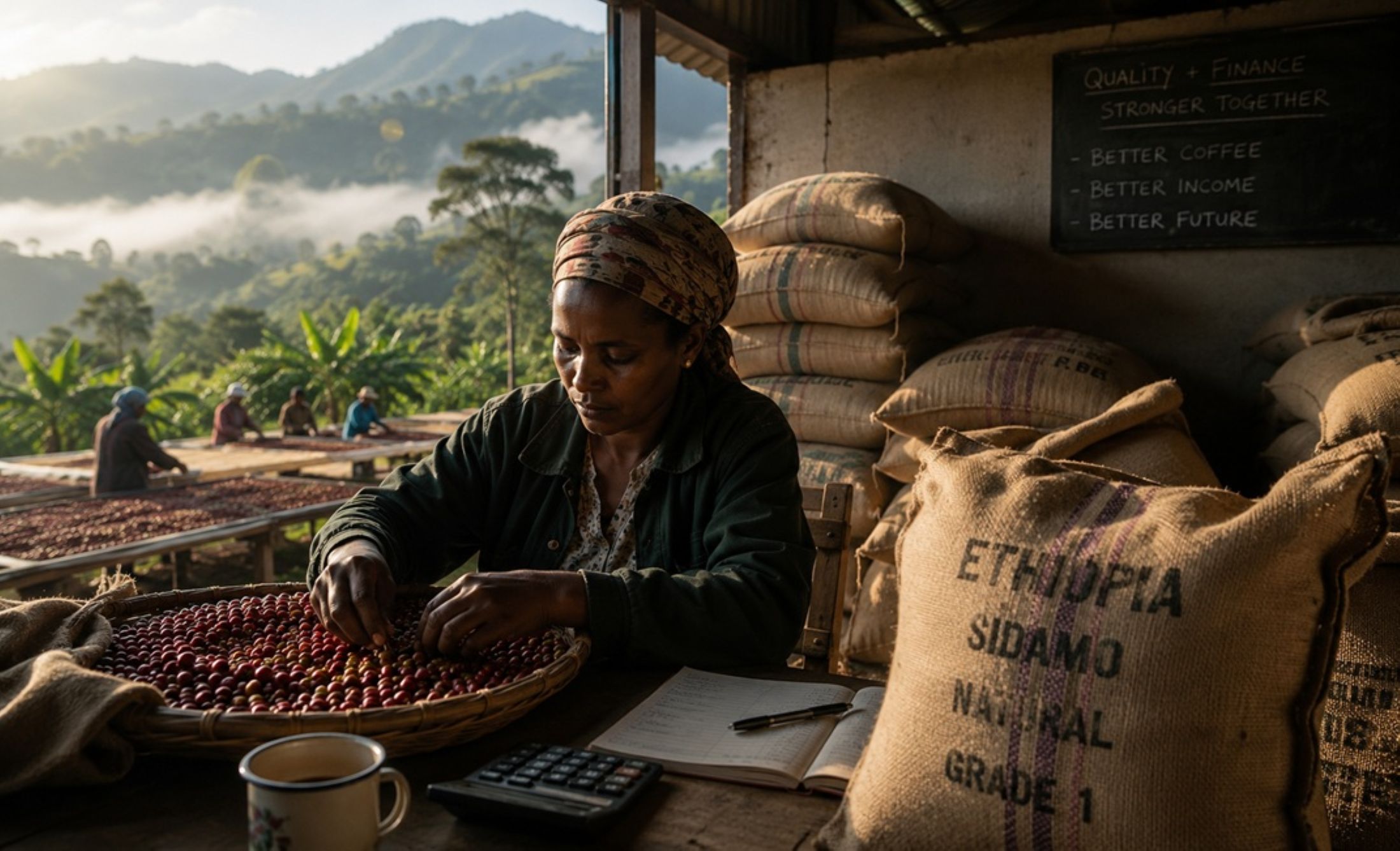
If you are like me, you enjoy your coffee. I have been privileged – I’ve had coffee directly from the producers in Colombia, Tanzania and most recently Cameroon. Most people experience coffee once it has arrived far, far away from where it came. I’d like to tell you a bit about the financial mechanisms that get it there.
I remember my mother buying the beans green and unroasted (you couldn’t buy it processed there) and she would dry them in the garden for a couple weeks, roast them in our oven, and then grind them. The smell permeated the house on those days. I loved it.
Coffee is one of the most traded commodities in the world, using complex value chains that stretch the globe.
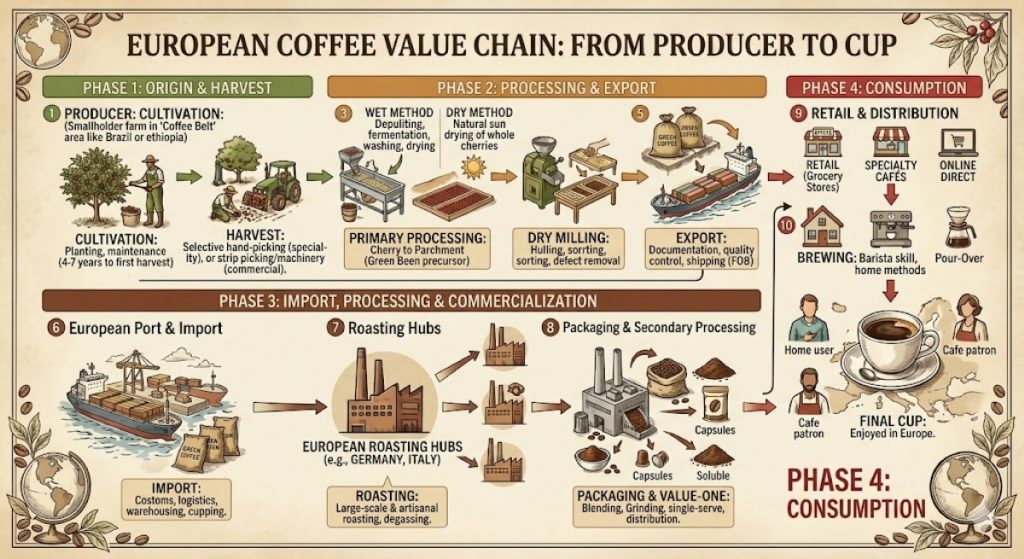
The Coffee Value Chain: from Producer to Cup (generated by Gemini)
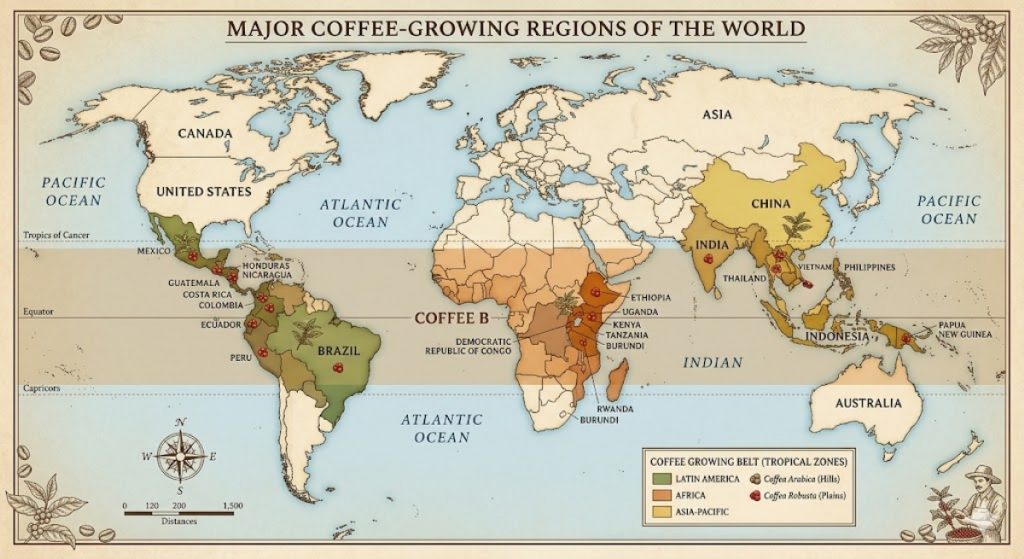
Though data is difficult to obtain (more on why a bit later), Fair Trade estimates 95% of coffee is grown on farms of less than 5 hectares 1, that is the vast majority of coffee is actually grown on farms operated by smallholders 2. The coffee growing areas of the world are actually quite wide, roughly extending to the area between the tropics. There’s a good chance your coffee comes from Brazil (31.3% of global production) or Vietnam (17.7%), far surpassing the more acknowledged producers in Colombia (7%) or Ethiopia (5.1%) 3.
Arabica is our diva. It can’t tolerate temperate climates because it will die with frost. But it also hates both extreme heat – the beans ripen too fast and decay – and humidity – it doesn’t like the bugs. So, it settles well in the high-altitude tropics where temperatures are mild and insects have more difficulty multiplying.
Robusta, as befits its name, is our ugly warrior. It similarly won’t survive frost, but it’s very happy in the blazing equatorial sun, takes in the tropical downpours, grows fast and hard enough that it doesn’t mind the insects. It is also more bitter and more caffeinated so much less attractive to them.
Major Coffee Growing Regions of the World (generated by Gemini)
Growing is a business
Regardless of where they grow, their caretakers have planted them on land they have used for generations. They know their trade, understand the (traditional) weather patterns, can recognise if their crop will be good or when their trees are suffering from a disease. Their problem is one familiar to any business owner: expenses come first, revenues come later. A farmer may spend money on seedlings, fertiliser and labour, months before a single bean is sold. And that doesn’t consider the emergency expenses during the growth phase (hike in school tuition for the kids, wedding gifts for the extended family, an unplanned health event). All of that with uncertainty of pricing.
The importance of cooperatives
To help, many coffee producers (as well as cocoa and other heavily traded consumer commodities) have joined cooperatives. Cooperatives often number hundreds, if not thousands, of smallholders. They come together for social bonding, to share news of their families, what’s going on in the neighbouring valley or of the wider world. Just as importantly, a farmer with two hectares may have little bargaining power individually. A cooperative representing 2,000 farmers is a meaningful commercial partner for wholesale purchasers. The cooperative helps negotiate prices with input suppliers (seedlings, fertiliser), provide a base of knowledge when required, rent machinery as part of a group, organise day labourers, and provides access to wholesale buyers. They bring down costs. But the cooperative itself does not have money (to buy the inputs or rent the machinery). That is where our first financial operator comes in – often a microfinance institution (MFI).
The bank that isn’t a bank
Though it has limitations, the MFI is the best financial actor at this stage. The microfinance model is based on providing short-term debt to a mass, in small individual volumes. The institutions have branches in rural areas, benefiting the smallholder with proximity. It can, depending on local regulations and institutions, provide savings products, payment and transfer services, or microinsurance. They often provide some kind of financial literacy training to their clients which can provide knowledge and tools helpful to the economic and personal lives of the beneficiaries. Wonder where the MFI gets part of the money from? We’ll come back to that.
Perhaps what makes them the best financial actor at this stage, though, is proper risk management for its market. When the MFI is analysing a loan to a smallholder, there is no product, the smallholder has little to no assets to hold as security, there is uncertainty of how much, once the product matures, will generate to the farmer. There is uncertainty as to weather events, pests, etc. The smallholders have competing financial obligations and very little to fall back on to meet them if times are tough. Rationally, this is an extremely high-risk investment the MFI is making. And it is 4 – commercial banks generally have better asset quality than microfinance institutions – but that is due to lower risk appetite and more security. MFIs have developed tools and methods to adapt to their market. Physical collateral is replaced with social mechanics (group lending, or working through cooperatives for example), they are more aggressive on timelines (banks typically report on non-performing loans at 90 days late, MFIs report portfolio at risk at 30 days late) 5. Perhaps most importantly, MFIs will take smaller initial risk (smaller loans) to new clients to identify character and capacity trends through experience 6. They are much closer to their clients both at inception of a loan and throughout its life. This makes the microfinance business model more expensive, but also sustainable.
When present, the MFIs benefit from working through and with cooperatives: they can reach larger scale while not altering their processes built around small individual loans, can interact with a core group of representatives when technical aspects need to be discussed, and simplify their disbursement and collection channels.
The cooperatives also benefit in simplifying the value chain – they can access finance to build warehouses from which the wholesale buyers can pick up the goods. Having these warehouses also allows better negotiating power – if prices drop, they can sit on the produce (for a while) to see if winds change.
At harvest the coffee beans, often picked manually with the help of day labourers and neighbouring farmers (generating employment and cash flow for local communities), are sun dried for about two weeks, then packed into bags to prepare for transport to the next actor part of the chain.
Local agents representing wholesale buyers and processors also need finance. Buying hundreds of tons of coffee at once is a strain on liquidity. In some cases, the MFI can step in here too with short-term debt finance, however the volumes often start to become difficult for an MFI to handle – granting such large volumes increases concentration risk, requires the institution to have efficient and effective collections and disbursement processes (to recycle the debt they disbursed to farmers into debt to the agents and recuperate it out of agents back into farmers). More often, banks can start to become interested: the volumes are larger which improves their efficiency, there is an existing product (no supply risk), the financial need is short (a few weeks), and given coffee in particular is such a structured market they don’t expect (too much) demand risk – if the product is of sufficient quality, a buyer will be found.
This latter point leads us to another important actor in the chain that leads to your morning coffee – the certifier. Once dried and prepared for export, the beans will be inspected by a certifier working on behalf of the importer. This ensures standardisation of product for the processor and consumer (you want the coffee brand you purchase to have the taste you know) and remuneration of the producer – the higher the quality the higher the remuneration (at least in principle). Some entities employ non-product specific certifiers – the Fair Trade Mark, for example, employs auditors to verify economic factors (minimum price to producers, effective use of premiums for water treatment facilities, schools or healthcare), social factors (health and hygiene for workers, equal pay for equal work) and environmental factors (GMOs, resource conservation, restrictions on use of certain chemicals). Though the quality certifiers do not pass through a financial actor directly, they represent a cost that is born by the importer and ultimately the consumer and thus is part of trade finance the importer will require from its partner financial institution. The cost of these certifications vary widely: from as little 0.2% of the green coffee value if the certification is food safety only to as much as 1.6% if the product is certified by the Rainforest Alliance 7. The size of the farm/producer/cooperative also plays an important role in the cost of certification. That may not seem that much, though they hide the heavy investments the farmers may have made upfront in order to qualify: water efficient irrigation, wastewater management, protective equipment for labourers, worker training, document management, traceability systems. All of these also have a cost which will figure in the final retail price.
The Risk Nobody Controls
Before we dive into the steps the coffee goes through once exported, we need to say a few words on the risks that must be shared, those that lead to price volatility. While farmers know their land and climate, these change over time. Use of chemicals can increase yield in the short term, decrease yield in the long term. Climate change is already very present in the regions of the world where coffee is produced (if you want to learn more here, do visit my colleague’s article on who’s to blame 8).
By relying on an ecosystem of actors and products, these risks are reduced for each actor – the burden is shared such that actors tend to survive shocks. Weather indexed insurance is particularly useful – in cooperation with an insurance company, an MFI or bank may offer the farmer to purchase an insurance policy whereby if temperatures or precipitation is outside certain parameters, the farmers receive an automatic pay-out that will help to lessen the impact of the loss of value on the harvest. These products are often a part of the loan structuring – clients pay for the insurance premium through debt that they repay as part of the loan they have contracted with the MFI.
The MFI has an inherent interest in protecting its clients – its long-term sustainability depends on clients continuing to produce. Thus, when negative events take place (a locust invasion, for example), the loan cannot be so much that recovery is impossible. The MFI will consider restructuring and repackaging loans to get the farmer producing again. An interest holiday can also be considered for the same reason.
When the Beans Leave Home
At this point, the coffee has been dried, put in bags, its quality certified and taken to a commercial port. It hasn’t yet been roasted though. Because your taste (wherever you are) is different from the taste in a neighbouring country, most coffee is roasted in the country of final destination. Much of the value added to coffee—through roasting, branding, packaging and retailing—is created once the beans reach consumer markets. All based on European spending capacity – not production costs.
Trade finance and working capital debt plays the second to last role in the financial value chain. The brand will pay for the logistics and the roasting thanks to its relationship with commercial and investment banks – the volumes here are in billions.
At the end of the chain, the supermarket or barrista will purchase the coffee for you to access your morning brew.
Global Map of Large Scale Coffee Import Flows & Roasting Hubs (generated by Gemini)
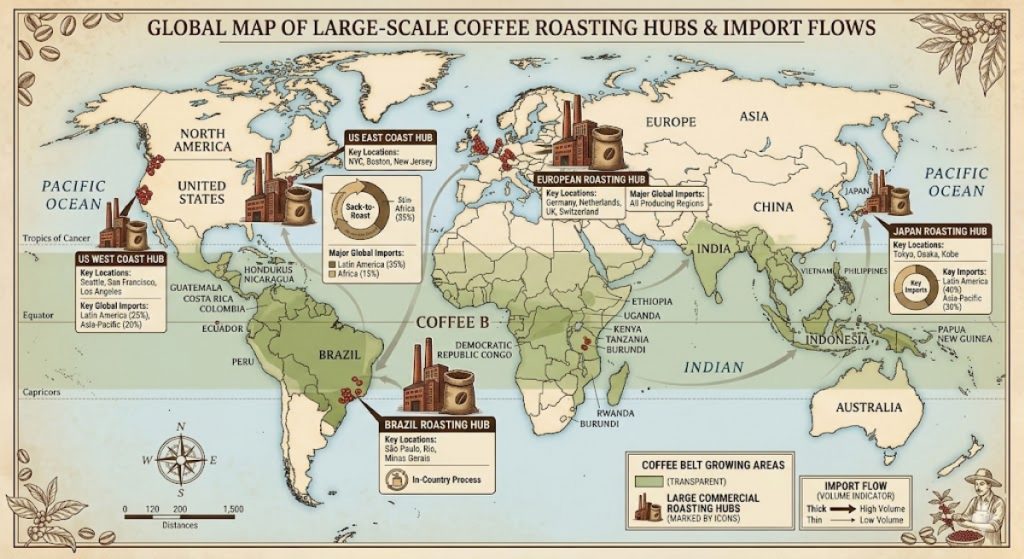
Thanks to this (simplified) value chain, you will find your next morning brew at the supermarket in neat 500g/1kg packages, depending on your consumption habits (1 guess as to how much I buy at a time).
The smallholder will likely never travel to the port city where his production was put on a boat. You will likely never travel to the hillside, exposed by a sun that is neither too hot nor too cold, where the plant that gave birth to the bean grew. Yet, between those locations, hundreds, if not thousands, were involved in the journey of that bean all the way into your morning wake up call. Among them were not only farmers, truck drivers, exporters and roasters, but also loan officers, cooperative managers, credit analysts and investors. The financial network behind coffee is largely invisible, yet without it the beans would never make the journey.
Can you play a role?
Yes. There are a number of microfinance investment vehicles (MIVs) operating in the European Union which are open to retail investors. These are run by professional fund managers with extensive experience in microfinance, know their markets, functioning business models and opportunities. We are one of them[1].
Most Europeans will never own a coffee plantation or work in agricultural development. But some choose to support these value chains indirectly through impact investment funds that provide financing to microfinance institutions. Those institutions, in turn, lend to the cooperatives and farmers who keep the coffee flowing.
[1] Abrar, A. (2023). What makes the difference? Microfinance versus commercial banks. Borsa İstanbul Review. https://www.econstor.eu/bitstream/10419/340396/1/1867260824.pdf
[2] Ibtissem, B. (2012). Credit Risk Management in Microfinance: The Conceptual Framework. FinDev Gateway / Munich Personal RePEc Archive.
[3] Agarwal, S., Kigabo, T., Minoiu, C., Presbitero, A. F., & Silva, A. F. (2023). Serving the Underserved: Microcredit as a Pathway to Commercial Banks. Review of Economics and Statistics, 105(4), 780–797. https://doi.org/10.1162/rest_a_01117
[4] https://fs-finance.com/portfolio-item/financial-inclusion/
[5] https://www.rainforest-alliance.org/business/certification/how-much-does-rainforest-alliance-certification-cost/
[6] See our colleague’s article https://fs-finance.com/articles/the-relevance-of-microfinance-for-biodiversity-conservation/
[7] Source : https://riskmap.fairtrade.net/commodities/coffee
[8] Smallholder farmers are defined by the Food and Agriculture Organisation (FAO) as farmers managing less than 2 hectares of land.
[9] Source : FAO Knowledge Repository. Percentages are average production between 2019 and 2023 to discount year/year volatility.