
How Market Constraints Shape Competitive Advantage and Organizational Design
There is a principle in architecture that translates surprisingly well into renewable energy project development: structure follows function. It means that systems, in this case the organizational structure of development companies, should not be designed based on aesthetic or institutional preference, but on what they are trying to achieve under real life circumstances. Renewable energy development is not static. Among other factors, it evolves with market maturity. To better highlight the different evolutionary phases of RE markets and how that translates into requirements for the structure, a second lens is helpful: the fire triangle of RE development. While the analogy is not commonly used in RE, it provides a useful way of explaining why RE developers/markets either scale or disappear trying.
Taken together, these two ideas form a simple but powerful framework:
“Structure follows function. Function is determined by the fire triangle.”
The fire triangle: what actually drives RE development
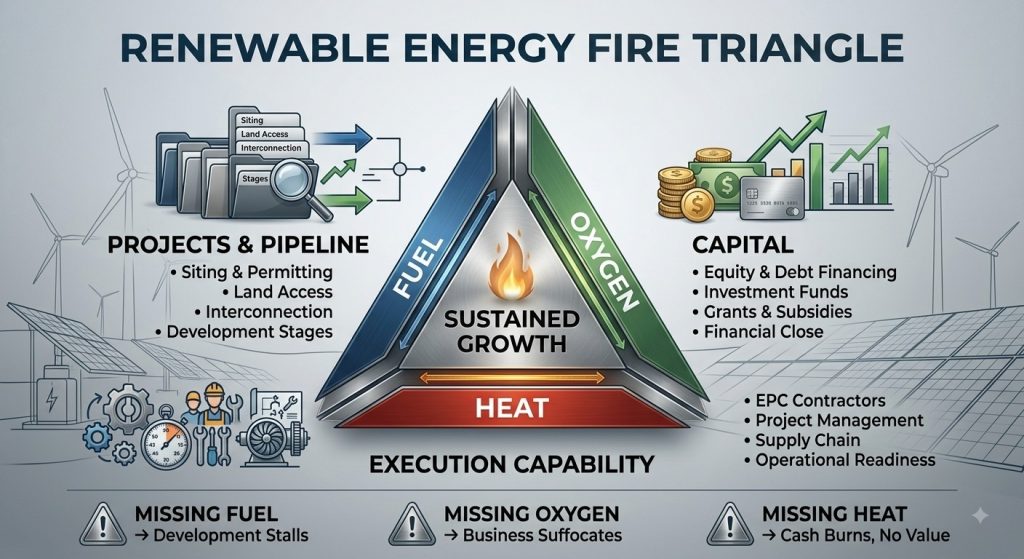
In fire, three elements must coexist for a reaction to sustain: Fuel, heat and oxygen. This can be applied to the renewable energy development context. The reaction becomes sustained growth or pipeline progression, and the equivalents of the individual elements are:
- Fuel → Projects and pipeline,
- Heat → Execution capability,
- Oxygen → Capital.
Remove any one of them and development stalls.
A huge pipeline and a strong team without funding? The business slowly suffocates. Capital and a broad asset base without execution? Cash burns without creating value. Experienced teams with funding but no projects? Nothing moves forward.
Graph 1: Visualisation of the RE Fire Triangle
While all combinations can happen at any time in a given market and the occurrence of these combinations follow market cycles, it is striking that certain markets are predominantly characterized by the absence or constraint of one of the elements. In the following I will try to explain three simplified archetypes using the fire triangle while later exploring what it means for the organizational structure operating in such an environment.
1. Nascent RE markets | Fuel constrained | Lack of pipeline
Nascent markets are defined by one core reality: fuel scarcity. Pipelines, meaning a set of defined projects at different stages of the development cycle guaranteeing an investment cadence with a predefined level of certainty, simply do not exist. Period. They must first be created. A lack of regulatory certainty, no established RE ecosystem and no clear path to commercialization are key characteristics of nascent markets. During this phase of market evolution, capital and talent/execution are often sitting on the sidelines (be it in neighbouring geographies or a different technology), waiting for the first few projects to be originated by first movers (in many cases local solo entrepreneurs) and getting involved by starting from scratch, via purchasing project rights or entering joint development agreements once the inherent risk-return profile allows it. Fuel/pipeline is the major constraint and subsequently project ideation is rewarded with the highest premium. To stay with the fire analogy, nascent markets can be described as the ignition phase. The spark either catches or it doesn’t.
2. Growth RE markets | Heat constrained | Inhibited Delivery
As the market develops, fuel begins to exist. Pipeline formation improves. Capital has entered the market and flows more easily. The fire is now lit. But it is still unstable. The constraint shifts from generating projects to executing on projects. Similarly, the highest development margin moves from origination to execution. During the growth phase, first projects have achieved financial close and have moved into construction documenting sector feasibility. The RE ecosystem has largely formed, the regulatory environment is stable and there is clear visibility to getting projects online. Speed, quality and certainty of development now outweigh the sole existence of projects. Developers who are developing faster, better and at a higher conversion rates will succeed. Competitive advantage now shines. Having a larger or deeper network, superior EPC conditions (also via vertical integration of the EPC business) or more competitive project finance terms will decide over the success of a developer.
3. Saturated RE markets | Oxygen constraint | Capital efficiency matters
In mature or saturated markets all three elements are present at scale: Projects are abundant and commoditized, execution is standardized and institutionalized, capital is readily available. However, the constraint as well as the margin shifts again and capital efficiency is now taking centre stage. With a standardized product and process, cost competitiveness becomes the differentiator. Since there are no input factors to renewables, driving down costs is almost entirely equivalent to reducing cost of capital. Securing suitable and competitive funding for development, acquisitions, mobilization and construction defines success and is often driving the evolution from pure play development to retaining stakes in projects/becoming an IPP. Furthermore, maximizing value per megawatt becomes the central objective. Value creation focuses now on different offtake strategies, portfolio management and trading/hedging of electricity. Revenues models get more sophisticated as companies offer EPC or EPC management, O&M and asset management services alongside development. In fire terms, the market has moved into a controlled combustion in a regulated environment. Predictable, optimised, and continuous.
Structural considerations
The fire triangle explains how markets evolve. The obvious question now becomes: what does this mean for organizations operating within them? If a company lives through the different market phases, the structure must evolve over time to adapt to the underlying market conditions. If the dominant constraint changes, the organization should change with it. Yet many RE developers treat organizational design as if it were a universal best practice rather than a response to market realities. This is exactly where we have observed a lot of emerging market RE developers misstep. They either get forced to adopt or implement structures themselves that are imported from mature markets; however, they fail to address the major constraint.
- In nascent markets, the objective is not to optimize an existing machine but rather building one in the first place. The organization therefore has to maximize its ability to identify sites, create projects from scratch and solve problems that have no established solution. Teams tend to be small, entrepreneurial and highly integrated. Individuals wear multiple hats, decisions are made quickly and functions such as development, commercial, engineering and permitting often overlap. This is not a sign of organizational immaturity but a rational response to an immature market, limited funding and limited resources. Every additional governance layer, reporting requirement or committee introduces complexity into the very activity that creates value: originating projects.
- As markets enter the growth phase, this same structure gradually becomes a constraint. Projects no longer fail because they cannot be found. They fail because they cannot be progressed efficiently through an increasingly standardized development process. At this point, specialization begins to outperform generalization. Dedicated engineering, permitting, grid, commercial and project finance functions emerge because they improve execution quality and increase conversion rates. Processes become standardized, project management capabilities become critical and knowledge that was previously concentrated in a few individuals becomes institutionalized. Organizational complexity increases, but it does so in service of a clear function: delivering more projects with greater certainty and at a higher pace.
- The transition to saturated markets requires another structural shift. Once projects become relatively homogeneous and execution is no longer a meaningful differentiator, organizational focus naturally moves towards capital allocation and portfolio optimization. Corporate functions that would have added little value during the early years suddenly become strategically important. Treasury, asset management, trading, portfolio optimization and sophisticated financing capabilities increasingly determine success. Similarly, governance structures become more formalized as businesses seek access to different pools of institutional capital with varying risk appetites. The evolution from a pure-play developer towards an independent power producer or integrated infrastructure platform is performed during this stage and is often less a strategic choice than a logical consequence of changing market conditions.
- This is where structures such as a DevCo/AssetCo setup, so the separation of the development business and the revenue generating assets, begin to make sense. By ringfencing the higher-risk development activities from operating assets, companies can align different risk profiles with different sources of funding and ultimately reduce their overall cost of capital. In a mature market, where capital efficiency is the primary source of competitive advantage, this additional complexity creates value.
However, applying the same organizational model in a fuel-constrained market (lacking pipeline) is often a textbook example of optimizing the wrong variable. Separating entities, establishing elaborate governance processes and raising capital across multiple platforms may improve financial efficiency on paper, but it also adds friction, e.g. regarding asset transfer pricing, and consumes significant management attention. When the primary challenge remains creating bankable projects, overengineered structures solve a problem that does not yet exist while distracting from the one that does.
Table 1: Framework Summary
| Market Stage | Constraint | Premium | Winning Capability | Structure |
| Nascent | Fuel | Origination | Creating pipeline | Entrepreneurial |
| Growth | Heat | Execution | Delivery | Functional specialization |
| Saturated | Oxygen | Capital efficiency | Portfolio optimization | Institutional |
Conclusion
A common misconception in RE development is that sophistication is mistaken for effectiveness. Mature market structures are often viewed as the benchmark to aspire to, regardless of local market conditions. Yet there is nothing inherently superior about a complex organization. Complexity is only justified when it addresses the market’s dominant constraint. An organization that is perfectly designed for Germany, the UK or US may be fundamentally misaligned with the realities of an emerging African or Southeast Asian market. Likewise, a lean entrepreneurial organization that thrives during market creation will eventually reach its limits once execution and cost of capital begin to determine success.
The objective is not to build the most sophisticated organization but the most appropriate one. The most successful RE developers are the ones whose structure is designed to extract the highest development premium by delivering on the most constrained market element. Structure should therefore evolve as the fire triangle evolves. As the constraint moves from fuel to heat and eventually to oxygen, so too should the organization’s priorities, capabilities and governance. Companies that recognize this evolution adapt naturally as markets mature. Those that fail to do so either remain unnecessarily simple long after complexity has become an advantage or become unnecessarily complex long before it creates value. Please give the fire what it needs to burn!
This article is inspired by the discussions of my fellow SCAF colleagues at the SCAF Energy Breakfast in Cape Town in June 2026 and broader observations on the evolution of renewable energy markets while working across developed and emerging geographies.